24/06/17

On the Tour de France 2017

France

The Tour de France, possibly the most incomprehensible international sporting event, starts in Dusseldorf (which is in Germany, not in France) on 1 July. It lasts for 22 days, and will cover over 3,500 km.  This is the 104th Tour and, for the first time in 25 years, will actually be going through all five mountain ranges of France.  

If you are an amateur you will have cracked the Byzantine code. If not, the jerseys, spotty, white, green (we all know what the yellow is), the domestiques (? servants), the lanterne rouge and the significance of a toy lion do not decode easily.  No matter, the Tour remains in France the greatest event of the year. Every bar has it on screen, endlessly analysed, endlessly criticised, often with ill-concealed resentment of Team Sky (it is rumoured that this year more hill stages have been introduced to remove them from their seemingly unshiftable lead).

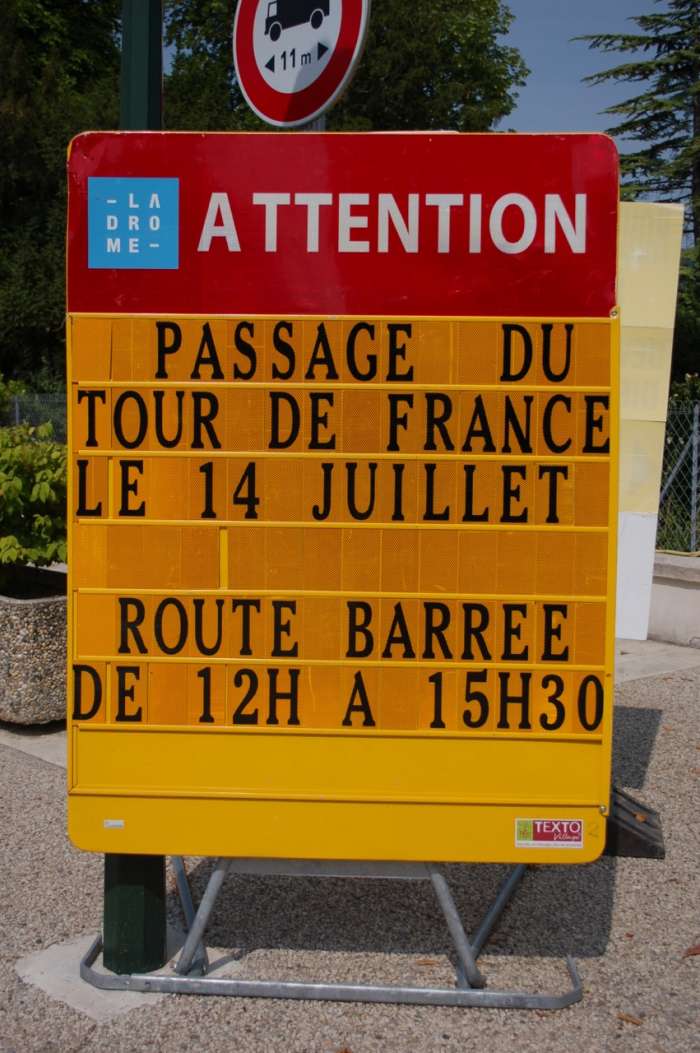
I live in the Alps and the race always passes nearby. Every summer, with neighbours and friends, many of whom have not been on a bike for 30 years, we pack the car and set off at crack of dawn to the nearest point where it will pass.  Tables are set up, lunch prepared and we wait. And we wait.  A rumble announces kilometres and kilometres of sponsorship trucks, spraying the crowd with sausages, chocolates and bottles of water.  The children scrabble in the verge.  Then we wait, and we wait.  Noon approaches.  It is very very hot.  Another rumble, motorbike outriders, helicopters, great cheering and whoosh, the peloton.  Blink and you miss it.  More cheering. Silence.  Cicadas.  Lunch. 
Cycling is a broad church, wider than many sports.  Last summer at the top of a particularly punishing col in the Baronnies I bumped into a 75 year old gentleman who told me he’d just done his 20th ascent of Ventoux.  His wife, who was 73, said she’d stopped doing it as it was getting a bit difficult.  

And so, this year, partly in the spirit of modest evangelism for cycling, and partly wanting to show Modern Salt readers the delights that lurk in some of the lesser known areas the Tour will pass through, we will be covering some of the stops on the route.  We will be looking at what goes on beyond the hotels you will find on bookings websites - we will be talking to farmers, vignerons, brewers, getting a real feel for the area and what it offers to those who want to visit, whether you are following in the slipstream of the peleton, or four wheels or on foot. We also have little vignettes - Japanese settlers in early 19th century Provence, a romantic tryst in impenetrable Pyreneen mist and first hand experience from a Normal Human Being of what it is like to actually cycle the route. 

For cyclists there will uploadable routes, tried and tested by locals, from the favourite local rides of Sven Teutenberg, who himself took part in the Tour and is now Director of Le Départ in Dusseldorf to those enjoyed by a local amateur club in Burgundy.

We have two partners, The Cycling Podcast and Tour de Force

Since 2013, The Cycling Podcast has covered the Tour de France with daily episodes analysing the race and taking listeners inside the greatest sporting show on earth.  For readers who are unfamiliar with the sport, TCP is rather like listening to a group of extraordinarily knowledgeable friends in the pub - and their enthusiasm and wit, and the little anecdotes at the end of the day are a real gem among the shouty testosterone.

For the journalists covering the Tour de France, the three-week journey around the country exposes them to the good, the bad and the mediocre that French restaurants have to offer.

Long days and late finishes mean that people working on the race often arrive just as restaurants are preparing to put the chairs upturned on the tables and flip the sign in the door to Fermé for the night.

So, we have teamed up with the Podcast to ensure their team of journalists manage to sample some of the finest, best value-for-money fare on around half of their stops this July. And for those Podcast listeners who feel tempted to follow some or all of the Tour route, Modern Salt will be writing about attractions off the main tourist beat, as well as suggesting feeding stations.  

This year, Lionel Birnie and Richard Moore have signed up the experienced French journalist François Thomazeau to join them on their journey.

With a deep love of the sport and unrivalled contacts in the peloton, the nightly podcast seeks to explain and entertain while capturing the changing flavour of the country as it passes under the wheels of the riders.

Meet The Cycling Podcast team…

Lionel Birnie has covered the Tour since 1999, writing for magazines and newspapers, but now works exclusively for The Cycling Podcast. He has also written a blog, Le Gourmet de France, which documents the best and worst of the cuisine he experiences on the road.

Richard Moore is a former racer who represented Scotland at the Commonwealth Games in 1998. As a journalist he has written several excellent books on cycling, most notably In Search of Robert Millar, Sky’s The Limit, Slaying the Badger and Étape.

François Thomazeau first covered the Tour in 1986. He has written numerous books, including Les Brasseries de Paris.

Simon Gill is a photographer whose work has appeared in Procycling magazine, The Times and The Guardian.(www.simongillphotography.com)

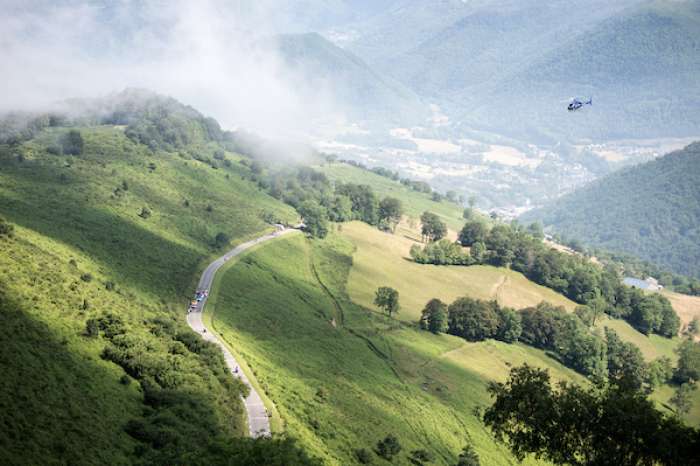
Stage 7 of the 2016 Tour - l'Isle Jordain-Lac de Payolle (photo Simon Gill)

Tour de Force is a charity set up by the William Wates Memorial Trust.  Will was murdered, aged 19, during his gap year in South America, and his four brothers set up the Trust to raise money for causes dear to Will’s heart, and most years a member of the family takes part in the ride (with varying degrees of athleticism, as they say).

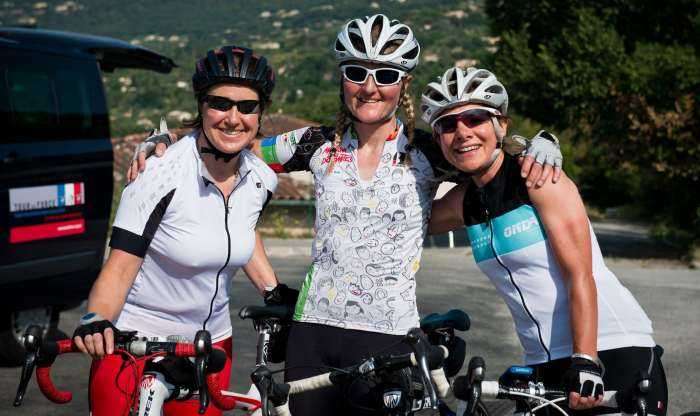
Unlike the real Tour, women take part in Tour de Force.  Marianne, Lee and Kerry on the 2016 ride.
Unlike the real Tour, women take part in Tour de Force. Marianne, Lee and Kerry on the 2016 ride.

The Trust’s aim is to help the most disadvantaged young people to fulfil their potential and to keep them away from a life of crime and violence.  The Tour de Force is their major fundraiser.  This year 140 riders are taking part, 40 of them doing the whole route a week before the actual Tour passes.

In charge of this extraordinary logistical challenge are two women, Sarah Perry and Kate Norris.

Sarah manages the logistics, with constant good humour.  She has worked in events management for 18 years and is herself a keen cyclist, having pedalled around China, Kenya, Russia and Jordan.  Deep down though, quite correctly, she knows that France is best.

Kate works with Sarah, focussing particularly on the fundraising aspect of the Tour.  She too has had long experience in event management and travel, and is a keen cyclist, often riding stages of the Tour with the group.

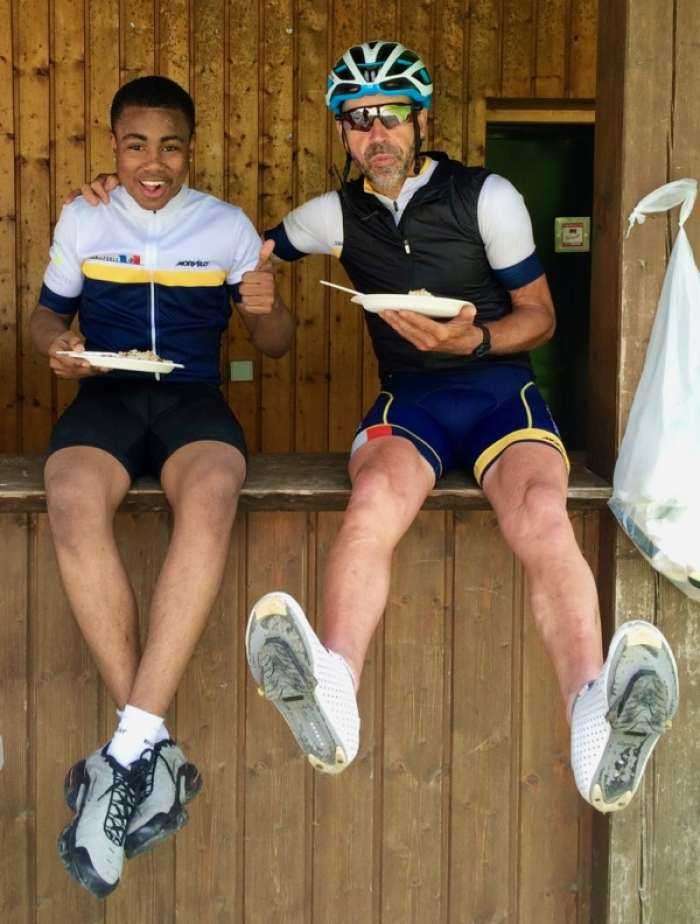
In addition to the riders raising money for the Trust, one or two students also cycle one of the stages.  For young men who have grown up in inner cities, often in hard conditions, this can be life changing.

Student Tyrese with Phil, one of the riders, on last year's Tour de Force (photo courtesy TDF)

To undertake the whole Tour is a major commitment.  It is easy to leap out of bed and on to the bike on summer mornings, but to keep the mileage up, week after week, through the British winter takes application.  The oldest rider is 71, and many are over 40.  We spoke to Paul Jukes (a sprightly 49),  one of the Tour de Force’s Ambassadors, about his experience.

Paul’s first Tour was in 2012, in the Pyrenées, and the following year in the Alps.  This year is the first time he will be doing the entire route.

Best moments? The camaraderie is fantastic, everyone has bad days, but there’s no rushing on ahead.  Even if it means cycling in the dark, nobody is left alone to finish the stage.  The support is wonderful - I am moderately obsessed with my lunchtime peanut-butter baguette and, despite having a huge crowd, all desperate for their calories, Sarah always has my huge sandwich waiting for me.

Worst moment? Without a doubt, Ventoux in 2013.  Set off far too fast and had completely burnt out by the time we got to Bédoin.  I burst into tears when I finally got to the summit!

We will be meeting up with the riders in the Alps, talking to them about their experience to date and getting a real sense of the race and the beauty of the landscape.

Paul Jukes having conquered the Pyrenees

So, one week till Dusseldorf. Shave your legs (just the men),  apply chafing cream and sunblock, pack gels and take lots of water.  Allons-y!

The Cycling Podcast is supported by premium cycling clothing manufacturer, Rapha and can be found on iTunes' Podcasts App and all other podcast Apps as well as at thecyclingpodcast.com

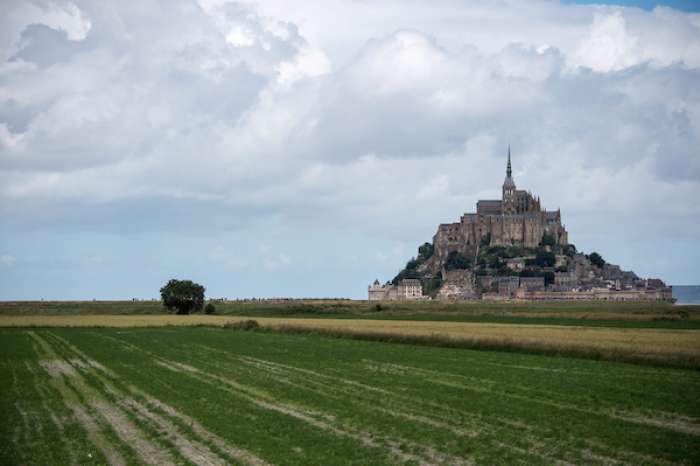
The Tour passes Mont Saint-Michel (photo Simon Gill)

and here is the Podcast's intro to the Tour.

Credits

Name Role
Simon Gill Photographs
Penny Averill Photographs