04/07/17

Longwy

Meurthe-et-Moselle

Like so much of France, Longwy seems like a great flâneur who has run out of chutzpah.  The Maginot line passes through the town, M Vaubon, never one to sit twiddling his thumbs, has erected substantial fortifications, but the glory has gone.  From vintage Veuve at the Café Royal to tea and a biscuit at a shelter. 

“What has gone wrong in France” is a question far too large for now and perhaps will be addressed by the new President.  For the moment, run down hairdressers and sad folk in tatty bars gaze balefully into the future.

As ever though, there are gems.  In the town itself the enamel works are well worth a visit.  Enamel was the industry of the town for centuries and is still flourishing.  The extraordinary azure blue is the signature colour of the pieces of the past, but the 20th century works, particularly the art nouveau, and the current collection are stunning.  You can see them, and acquire if your resources allow, at the workroom/shop in the centre of the town.
Art Nouveau vase
Vase, 2016

Lorraine is a beautiful part of France, overlooked by many British as it’s not on the route south.  If you can brace yourself for  Belgian motorways (narrow two-lanes and road surfaces which would give US freeways a run for their money in terms of potholes, discarded metal, broken glass) just before Luxembourg, there it is.  Huge rolling hills and dark forests.  Wonderful cycling country and, in the tiny villages with unpronounceable names, wonderful things are happening.

Some of Marie-Pierre's conserves

Marie-Pierre Blondin Lana and her husband Joel, have returned to traditional bio-dynamic farming, selling from their home in the tiny village of Boismont, and in local markets.  Fruit is bottled in the traditional way, soups are made from wild garlic (great swathes of it all over the fields in April when Modern Salt visited), sorrel and carrots. They raise cattle, Charolais for beef and rosé veal, and Fresian for milk.  They have a huge local following, simple good food, which is more and more difficult to find in France.

The dining room at the Ferme Auberge Sainte-Mathilde

And where to eat?  There is nowhere in the town, but two gems are very close.

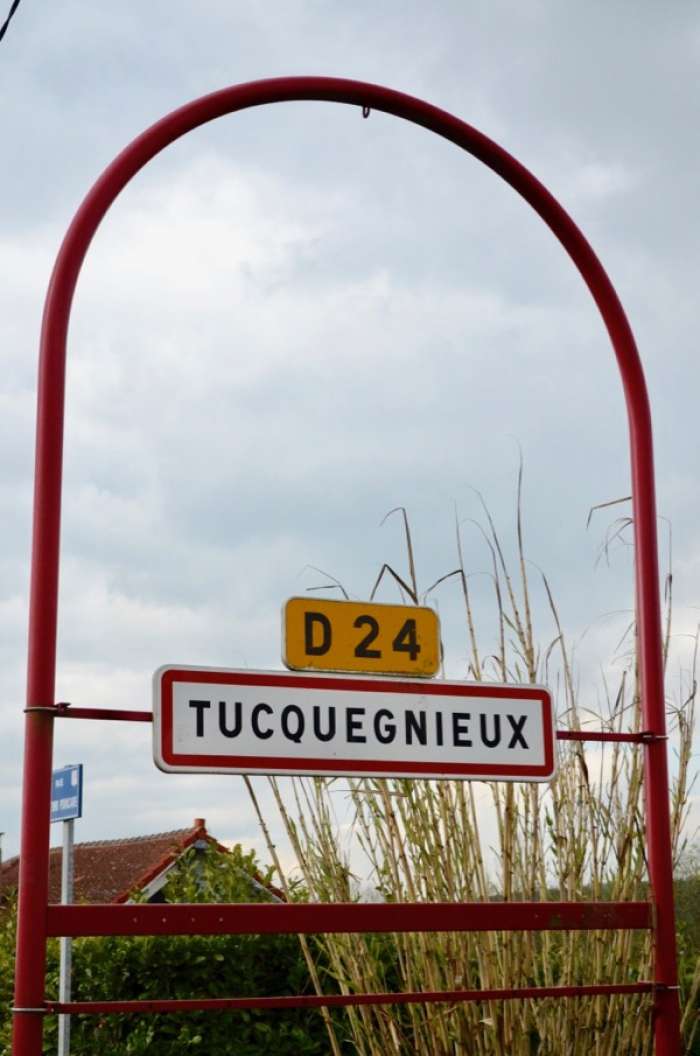
The Ferme Auberge Sainte-Mathilde is in the unpronounceable village of Tucquegnieux.  A beautiful 16th century house which has been restored by Virginie and Thierry Herr and their parents.  The walls have been left naked and they have a honey coloured luminescence.  This is not a restaurant - you must reserve in advance and be a group of at least 6 and you eat whatever Virginie has cooked.  The food is all from their farm - cous nus chickens (rather alarming on first sight, looking rather like refugees from a battery farm), rabbits, pigs.  Sublime fromage frais is made from the raw milk of a neighbour’s herd of cows and 18 different vegetables are grown in the potager.

I am not a battery chicken but a perfectly healthy cou nu.

If you are alone or in a smaller group you should visit Aux Délices de Bacchus, in Mexy.  Dominique and Jacqueline Pezzin have had their restaurant since 1993.  Dominique trained under Michels Guérard and Sarron and everything, from the first piece of bread to the last petit-four is made by him.  There is a wine list with a lot of the nearby Alsace, but also some Côtes de Toul, the local wine. 

Longwy ends the second full day of cycling for the Tour.  Over to Lionel, Richard and Francois:

Credits

Name Role
Penny Averill Photographs